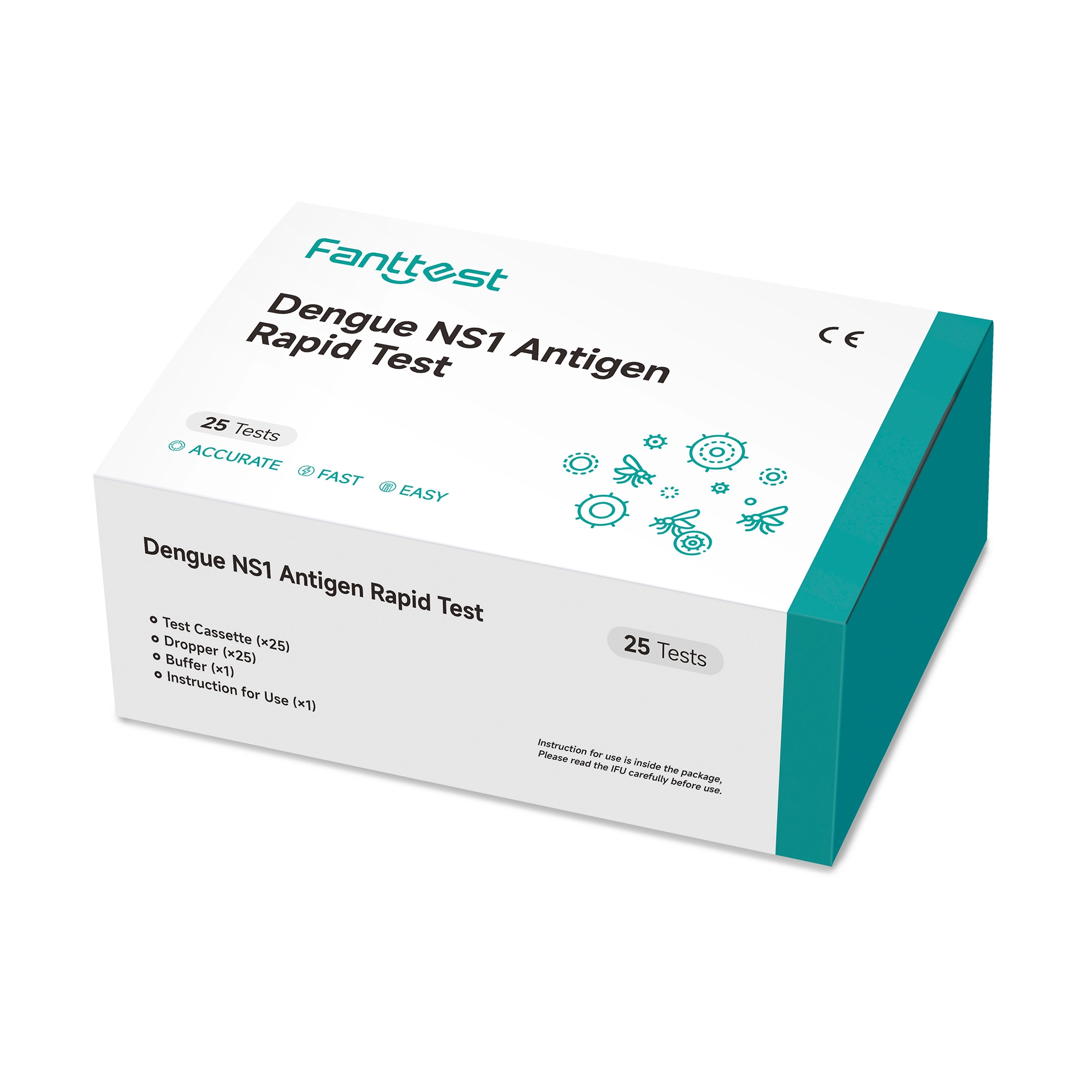
NS1, IgM, and IgG provide different information in dengue testing. The NS1 antigen is more suitable for the acute phase early in infection, IgM generally becomes more useful for detection several days after symptoms appear, while IgG is primarily used to determine whether there has been a previous infection or to assist in assessing secondary infection.
For patients within the first 7 days after symptom onset, CDC currently recommends either nucleic acid testing combined with IgM testing or NS1 antigen testing combined with IgM testing. After 7 days of illness, IgM generally becomes a more important serological indicator for determining recent infection.
NS1 is a protein of the dengue virus that can enter the bloodstream early in infection. Therefore, before the patient's body has produced sufficient antibodies, NS1 testing is generally more valuable.
Dengue NS1 antigen testing is generally suitable for the first few days after symptoms appear. CDC notes that NS1 can usually be detected within 0–7 days after illness onset, but its detection sensitivity may gradually decline as the illness progresses.
A positive NS1 result supports the presence of a current or recent dengue infection. However, a negative NS1 result cannot completely rule out dengue, especially when testing is performed later or the patient's clinical presentation remains highly consistent with dengue.
IgM reflects the patient's developing immune response rather than directly detecting the virus itself.
Dengue IgM antibodies typically begin to reach detectable levels approximately 4–5 days after symptoms appear and may persist for about 3 months. Therefore, when a patient is no longer in the earliest stage of infection, IgM testing is often more informative.
During the first week of illness, IgM generally needs to be interpreted together with NS1 or molecular testing, because an early negative IgM result cannot reliably rule out infection.
IgG results require more cautious interpretation.
The presence of IgG in a single sample may reflect a previous dengue infection and does not necessarily indicate the current illness. Therefore, CDC does not recommend diagnosing acute dengue infection based solely on a single IgG test.
However, IgG can still provide valuable background information, particularly when assessing possible secondary infection or comparing paired acute-phase and convalescent-phase samples. In secondary infection, IgG often appears earlier and may reach higher levels than in primary infection.
As the infection progresses, the most valuable testing indicator also changes.
| Stage of infection | NS1 | IgM | IgG | Practical interpretation |
|---|---|---|---|---|
| Days 1–3 | Usually valuable | Often negative | May reflect a previous infection | NS1 usually provides more information early on |
| Days 4–7 | Still valuable | Begins to become detectable | Needs to be assessed with the infection history | NS1 + IgM can broaden testing coverage |
| After day 7 | Decreased value | Usually more valuable | Can assist in assessing infection history | Serological testing becomes more important |
| Secondary infection | May still be detectable | Response may differ | May rise rapidly | Multiple indicators need to be interpreted together |
This change in the testing window over the course of illness also explains why dengue igg igm ns1 combined testing has certain practical value: it can assess multiple indicators within the same testing process rather than relying on a single indicator at every stage of infection.
Testing time is one of the most common reasons.
As the illness progresses and the immune response strengthens, the value of NS1 testing generally declines gradually. Therefore, when patients are tested later in the course of infection, they may have a negative NS1 result but a positive IgM result.
In addition, sample quality, testing method, viral load, and whether the patient has a primary or secondary infection can all affect test performance.
Therefore, when the clinical presentation strongly suggests dengue, NS1 should not be treated as a completely independent “positive or negative” indicator.
They can provide some supporting information, but the results must be interpreted cautiously.
In primary infection, IgM usually appears first, followed by IgG. In secondary infection, because the patient has previously been exposed to dengue virus, IgG may appear earlier and rise more rapidly.
However, antibody responses can vary between individuals, and serological tests may also cross-react with other flaviviruses, such as Zika virus or West Nile virus.
Therefore, IgM and IgG results should be interpreted comprehensively together with the sampling time, clinical symptoms, epidemiological exposure history, and other laboratory results.
The core value of dengue igg igm ns1 combined testing is that it broadens the testing window throughout the course of the disease by detecting both early viral antigens and later antibody responses.
This testing approach is particularly meaningful in practice when patients cannot accurately report when their illness began. The patient may still be in the early stage when NS1 is suitable for detection, may have already entered the stage when IgM is more valuable, or may have antibody results affected by a previous dengue infection.
Therefore, compared with testing a single indicator alone, multi-indicator combined testing can provide more complete information. However, rapid test results should still be interpreted according to the product instructions and local clinical guidelines.
NS1, IgM, and IgG answer different questions in dengue testing.
Dengue NS1 antigen testing is more suitable early in infection because it can detect viral antigens before a complete antibody response has developed. IgM usually becomes more valuable several days after symptoms appear and is an important indicator of recent infection. IgG primarily reflects previous exposure and can assist in assessing secondary infection, but it is not suitable for diagnosing acute dengue on its own.
For patients presenting at different stages of illness, the dengue igg igm ns1 combined testing approach can provide broader coverage throughout the diagnostic window.
NS1 can usually be detected during the first few days of illness and is mainly used during the first 7 days after symptoms appear.
IgM typically begins to reach detectable levels approximately 4–5 days after symptoms appear.
Not necessarily. A positive IgG result from a single sample may also indicate a previous dengue infection.
Yes. Their detection windows may overlap during the middle of the first week of illness.
No. Especially later in the course of illness, a negative NS1 result cannot completely rule out infection.
Because the three indicators appear at different stages of infection, combined testing can provide broader testing coverage when the timing of illness onset is unclear.