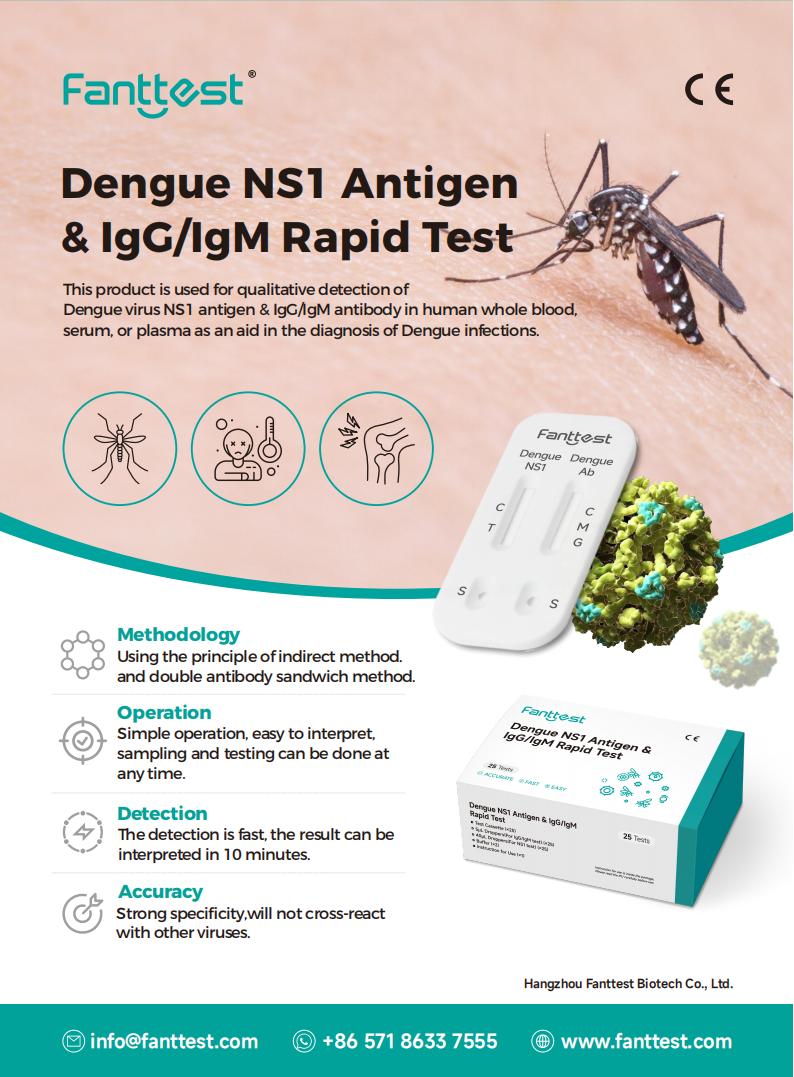
In dengue-endemic regions—from Southeast Asia’s bustling cities to Latin America’s rural villages—prevention has long been a challenge: without clear insights into infection status, patients often struggle to avoid actions that worsen risks, protect loved ones, or adapt to their health needs. Now, the Dengue NS1 Antigen & IgG/IgM Rapid Test is changing this narrative, emerging as a key tool that empowers patients to take proactive steps in dengue prevention, beyond just diagnosing active cases. For millions at risk, this test turns “reacting to illness” into “preventing harm”—a critical shift in the fight against a disease that affects 390 million people yearly.
1. Early Infection Detection Stops Unintentional Transmission to Family & Communities
One of dengue's biggest prevention gaps is “silent spread”: patients with mild early symptoms (or no symptoms at all) may unknowingly expose family, colleagues, or neighbors—especially since mosquitoes can pick up the virus from an infected person 24-48 hours before symptoms appear. The rapid test’s ability to detect NS1 antigen (1-9 days post-exposure, even pre-symptomatically) lets patients identify infection early. For example, a shopkeeper in Indonesia recently tested positive via the Dengue NS1 Antigen test kit after feeling mild fatigue—he immediately isolated himself at home, avoided close contact with his young children, and asked family members to use mosquito nets rigorously. “Before, I would have gone to work and cared for my kids, never knowing I was spreading dengue,” he said. By catching infections early, the test helps patients break the transmission chain, protecting vulnerable groups like children, pregnant women, and the elderly.
2. IgG Antibody Insights Guide Long-Term Prevention for High-Risk Patients
Repeat dengue infections are 300% more likely to lead to severe disease (e.g., dengue hemorrhagic fever), making long-term prevention critical for those with a history of the virus. The rapid test’s IgG antibody detection (which reveals past infections) gives patients clarity on their risk status—and lets them tailor prevention habits accordingly. A teacher in Thailand, for instance, learned she had IgG antibodies after a routine test. She now takes extra precautions during dengue season: wearing long sleeves and pants outdoors, using EPA-approved mosquito repellent daily, and ensuring her classroom has screened windows. “Knowing I’m at higher risk made prevention non-negotiable,” she explained. For patients with IgG positivity, the test also prompts closer collaboration with doctors: many now schedule regular check-ins during peak dengue months, ensuring they get immediate care if symptoms reoccur—avoiding delays that fuel severity.
3. Post-Recovery Guidance Prevents Reinfection & Complications
Even after recovering from dengue, patients face risks: weakened immunity in the weeks post-recovery makes them more susceptible to reinfection, and ignoring follow-up care can lead to lingering health issues. The rapid test plays a role here too: post-recovery, doctors use it to confirm the clearance of NS1 antigen (signaling the end of acute infection) and recheck IgG/IgM levels to gauge immune status. A farmer in Brazil, for example, tested negative for NS1 antigen 2 weeks after recovery—but his IgG levels remained high, prompting his doctor to advise extended mosquito protection. “I thought once I felt better, I was safe,” he said. “The test taught me I still needed to be careful to avoid a worse second infection.” This guidance helps patients avoid premature relaxation of prevention measures, reducing reinfection rates and long-term health impacts.
.jpg "dengue-ns1-antigen-igg-igm-rapid-test-a-powerfully-for-patients-in-preventing-dengue-risks_(2).jpg")
4. Empowers Travelers to Stay Protected in High-Risk Destinations
For travelers visiting dengue-prone areas (e.g., Thailand, Costa Rica, India), uncertainty about pre-travel immunity or post-trip exposure often undermines prevention efforts. The rapid test solves this: pre-travel, it can check for IgG antibodies (revealing if a traveler has existing protection from past infection, reducing anxiety about first-time exposure). Post-trip, if a traveler develops fever or body aches, the test quickly rules out or confirms dengue—letting them avoid risky self-medication (e.g., aspirin, which increases bleeding risk) and take steps to protect others at home. A tourist from Canada recently used the test before a trip to Vietnam: learning she had no IgG antibodies, she stocked up on repellent, booked accommodation with mosquito nets, and planned indoor activities during peak mosquito hours. “The test didn’t just give me peace of mind—it made me prepare smarter,” she said.
In a disease where prevention is as vital as treatment, the Dengue NS1 Antigen & IgG/IgM Rapid Test stands out as more than a diagnostic tool. It equips patients with the knowledge to protect themselves, their families, and their communities—turning passive vulnerability into active prevention. For dengue-endemic regions, this isn’t just a medical advancement; it’s a way to put patients in control of their health, one rapid test at a time.